Doctor and activist


Notice: Undefined index: hide_archive_titles in /home2/chesterf/public_html/wp-content/themes/modern-business/includes/theme-functions.php on line 233

Category: Health

Submission to Senate Inquiry into Newstart 29/9/2019

Introduction

This submission addresses the Terms of Reference in order. It is written from practical experience, economic knowledge and with some research. Areas in which the author does not have expertise are not mentioned. This does not mean that they are unimportant.  Comments on policy are made in relation to the term of reference, even if they are not directly asked in that term.

  1. An Acceptable Standard of Living including housing.

Two of the Four Freedoms in the UN Declaration of Human Rights are Freedom from Want and Freedom from Fear.  It is necessary that in Australia with a relatively high national income that people have enough money for food, shelter and some money to associated with others and enjoy some quality of life.  The amount of money needed for this last depends to a considerable extent on how much society’s resources are free, such as parks and health care, how much they cost such as transport, and this to some extent depends on the extent to which monopoly products, such as roads have been privatised.

The most critical item is usually accommodation. The widespread use of negatively geared real estate as an easy route to riches for those who have surplus income has led to property being seen as an asset class that cannot lose money and almost a national Ponzi scheme where everyone buys on the assumption that prices will continue to rise. This has been self-fulfilling[i], but the national private debt has grown enormously[ii], which economists have been concentrating on public debt.  The bottom line of this is that property has risen hugely in value, and in 2016 the median Sydney house price was 14 times the median income[1], but most of this value is in mortgage debt, which our banks have borrowed from foreign banks.  So those who have cashed out their capital gains have done so at the expense of those who bought, and as a nation, Australia still carries the debt, requires large interest repayments, creates a national vulnerability to a fall in our dollar and limits Australia’s ability to invest in more productive assets or industries[2].  The national obsession with real estate has been worst in Australia than other countries, and this must surely relate to the negative-gearing tax legislation.

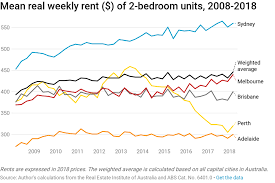
At a practical level, rents have risen as property prices rise and this has been worst in Sydney.  People on fixed incomes simply cannot afford shelter, and this is compounded by the almost complete cessation of the building of public housing, which has resulted in housing stock being taken by those on welfare or with age and disability, creating a subculture of welfare dependency with few role models.

It is therefore an oversimplification to see the problems as just one of income.  But to address the problem requires pro-active policies in social structures and resources as well as infrastructure and education.

Given that many landlords see their properties as an investment, they are naturally keen to maximise returns. As prices rise the rental returns fall as a percentage of capital invested, even if that capital was not invested by the landlord, but is a function of the overall market price rise.  Since house prices are rising much faster than inflation, there is therefore pressure on rents to rise faster than inflation and faster than wages.  Unsurprisingly, landlords and agents often encounter resistance from tenants when they try to get rent rises greater than inflation. It is therefore easier simply to terminate the tenancy and start again with ‘market rent’. This leads to tenants being forced to move every year or so, and always having to take the rent rises.  This has meant that rents have been an ever-increasing share of incomes particularly in Sydney. The dislocati0on associated with forced moving is an ever-present reminder of the power structures in society and a significant demoralising factor for a considerable segment of the population. 

The changes in tax so that housing investment was seen as more long-term might begin to addresses these problems, but it requires some political courage as the idea of negative gearing is embedded in the society.  Property investors are aware that they are getting rich by borrowing but less aware that the selling to get rich relies on someone else’s borrowing and cannot be sustained at a nati0onal level.

  • the labour market, unemployment and under-employment in Australia, including the structural causes of long term unemployment and long term reliance on Newstart;

Governments in Australia need to face the fact that there are not enough jobs for the Australians who need them and that the price structure is moving in a direction that is worsening the situation. There are a number of reasons for this:

  1. The use of automation to replace labour, resulting in the closure of many offices and factories
    1. The mobility of information, capital and goods that has allowed competition from  cheap labour countries to replace Australian industries with a big competitive advantage in cost structures, so that more goods are imported.
    1. The weakening of unions and the rise of labour hire companies that has allowed for increasing sub award wages, cash payments and a reduction of job security.
    1. The use of work visas for unskilled labour, creating a sub-class of workers in the agricultural, cleaning services, hospitality and semi-skilled building industry where low wages are paid and Australian residents do not even compete for jobs.

It begs credibility that the Government is unaware of what is happening as they increase the number of unskilled workers to come to Australia on temporary visas, leave the unions emasculated and the Fair Work Tribunal under-resourced for any sort of policing role.  The large number of foreign students who are in Australia as paying University fees who also need work and are a significant pool working illegally, again for cash or sub-award wages. Naturally they are in no position to complain, so act to lower real paid wages, even if they have no direct effect on statutory rewards.  Australian government must face the reality that Australia’s cost and price structures are such that employers cannot compete on price in many cases and have therefore become importers.  Structurally there will a continuing and probably worsening problem that many Australians will be unable to get jobs, and there needs to be a national strategy to create industries that are world competitive in a balance of payments sense and which will create lasting employment. Failing that Australia could take a Middle Eastern or Norwegian solution that charges far more royalties to companies exporting our resources and invests these in long term assets to support our economy. The development of renewable energy has been suggested as an export industry to develop, but it appears that the influence of the coal lobby is undermining innovati0on in this area.  Those who chronically cannot find work remain on Newstart and the demeaning effect of continually applying for jobs that do not exist must demoralise even the most resourceful person. The ghettoization of poverty as outlined above compounds this, and it is surprising that there has been so little backlash from employers getting thousands of job application that they have no possible positions for. Presumably such correspondence is easy to ignore and dispose of. 

The policy that allows ‘choice’ in schools and subsidises bus fares for children of more upwardly mobile families to attend either private schools or schools in better locations also leads to a residualisation effect where those who have less choice are all together and social disadvantage tends to be concentrated, so that there is less social help available in terms of knowledge and resources in the neighbourhood.  Shortage of capital compounds this.

All this means that there are long-term structural problems in the Australian economy, which are compounded by the inequality of opportunity in the education sector.  Currently this effects disadvantaged people more, so can be ignored by the more privileged classes if governments choose to ignore the long-term implications for the society as a whole. There are some in government who think that they are only there to get a larger slice of the pie for their own voter segment and that they do not have an overall responsibility for the progress of the nation.  This approach must not be allowed to dominate, as a refusal to recognise the above structural issues will simply compound the difficultly as addressing them in the medium term.

Clearly those that are inappropriately trained or those who try to insist on an award wage where this has been allowed to be totally eroded, will be unable to find work and will need NewStart for a long time, particularly if there are not enough jobs.

  • the changing nature of work and insecure work in Australia

The changing nature of work as noted in b. above means that many jobs are either displaced by technology or ‘offshored’ where wages are cheaper.   There are also an increasing number of ‘guest workers’ on 457 Visa who are supposedly skilled and now there are provisions for unskilled workers[3] under designated area migration agreements (DAMAs). These people are supplemented by the large overseas student body who often also need work, but are legally restricted in how much or how long they can work, making them ripe for cash jobs, sub-award wages and exploitation.  With foreign workers at least 10% of the workforce, and union membership plummeting, there is very little enforcement of pay and conditions.  It also seems that governments want to turn a blind eye to the situation. Employers in the Northern Territory readily concede that DMA mainly are in the hospitality and tourist industries, which could presumably be done by native Australians. If native Australians are only to get ‘better jobs’ then the government which is allowing all these jobs to be taken by temporary workers ought either organise such jobs or stop blaming those in Australia who do not have jobs.  It may be that if fruit pickers were paid award wages the Australian fruit could not compete in the market, but with a consumer premium on Australian product and possible action to reinforce this, it is unlikely to be the case if a real effort were made at an all of government level.

As far as the 457 visa are concerned, many of the trades coming to Australia, such as tiling, gyprocking, cement rendering, plumbing and cooking could be done by Australians, but the educational emphasis on universities and training in the medical, legal and financial areas and the deliberate neglect of TAFE, technical skills and apprenticeships has meant that Australia has a huge oversupply of wannabe CEOs and a severe shortage of tradesmen.  What training our youth have is not actually appropriate for our long term needs. The two concepts of making education a for-profit exercise and letting ‘the market’ decide as if it has intrinsic wisdom, has made many young people do inappropriate training, before ‘the market’ teaches than the error of their plans.  Governments may not be able to predict exact numbers of each occupation needed in the next 20 years, but they should at least make an effort.  The absurd mismatch of skills needed and current training practices begs serious attention.

Employers, facing competition from imports with lower wages structures have lessened their cost by making work casual and only paying for workers when they are needed. From an employee’s point of view the casualisation of work means that they do not have  stable income, which has both immediate effects and also longer term ones in that they cannot get home loans or even rental properties on that they cannot show that they will be able to meet financial commitments reliably. This further marginalises many workers and adds to social inequality.

  • the appropriateness of current arrangements for supporting those experiencing insecure employment, inconsistent employment and precarious hours in the workforce

The Author does not fully understand the overall situation with regard to current arrangements but can make some observations and recount anecdotes that relate to experiences as a professional coming into contact with support systems.  The author currently works as a doctor treating Workers Compensation and Motor Vehicle accident injuries, so observes the action of insurers who act as private support for these people and also Centrelink in terms of people getting NewStart or the Disability Support Pension.

It might be noted that the NSW government has made legislative changes to reduce the time that workers compensation and third party insurance are paid to 5 years and to give insurers more discreti0on to deny payments to injury victims. This was in order to be able to lessen premiums and be able to claim that the State was ‘business friendly’.   The premiums have fallen and the private insurers have had a windfall, but this has been at the cost of payment to injured workers, both in terms of treatment denied and in terms of income benefits obtained.  The author wrote a detailed submission to the Hayne Royal Commission re this.

The effect of this legislation has been to force people who were on compensation to seek either NewStart of the Disability Support Pension from Centrelink.  I might be noted that the Workers Compensation legislation of 2012 gave long-term compensation patients another 5 years of support, but this came to an end in December 2017.  Most of these patients had been on compensation for more than 5 years, despite the funded rehabilitation and job training programmes.  It might be stated that his gave them a better chance of finding a job than others in the same physical condition who had not been injured at work.  Nevertheless Centrelink has resisted putting many of these people on the Disability Support Pension and insists on NewStart for many people.  A discontinued survey be SIRA (State Insurance Regulatory Agency of NSW) found that only 29-30% were on some sort of benefit.  8% had been declined by Centrelink, 12% were still being assessed by Centrelink, 18% had too many assets to get a benefit (and leaves 32% not mentioned)[4].  Prime Minister Morrison boasted that fewer people were being put on Disability Support Pensions, but this actually started under the Gillard Government. The author has a patient, a migrant illiterate in English, and probably his own language who was 61 years old, had been on Workers Compensation for a back injury, had Parkinson’s disease and was a carer for his sick wife and was refused a DSP. His chance of getting a job was negligible.  When the doctor took some time to write a detailed report to help the man, Centrelink stated that they would not pay more than $150 for the report, which took a couple of hours to do as his medical history was very complicated.  He was forced onto NewStart and given a provider and lot of literature on ‘mutual obligations’ that he was not even able to read.  Attempts to call Centrelink result in waiting times on the phone of up two hours. A computer eventually answers the call and cuts the person off if they cannot give the number and its suffix (which it may not have) in a very short time.  If complaints on the website are not filled in in a certain time, the site simply switches off, losing the draft complaint.  The systemic arrogance and indifference shown by Centrelink to its clients has to be experienced to be believed. 

The author recommends that all the Committee assessing this issue try to contact Centrelink by phone, attend an office and personally interview a few people in the situation. 

  • the current approach to setting income support payments in Australia

It would appear that the level of benefits is set historically and rises only when political pressure is applied to the system.  There does not appear to be any logical formula setting the level of benefits in relation to costs, inflation, rents or the poverty line.  If this is indeed so, it is no basis to run the welfare system of a country with systemic unemployment and the need for some degree of equity to maintain social harmony. If Australia has boom times it is fair that the success be shared, if there are bad times, it is fair that the pain also be shared and the effects of downturns not borne disproportionally by the most disadvantaged.

  • the impact of the current approach to setting income support payments on older unemployed workers, families, single parents, people with disability, jobseekers, students, First Nations peoples, people from culturally and linguistically diverse backgrounds, people living in regional and remote areas, and any others affected by the process;

The author does not have quantitative data on the impact of different groups, but has anecdotal evidence of patients utterly depressed about how they were treated by Centrelink, in despair about their ability to pay their bills and expressing a lack of hope for the future and suicidal ideation.  Older workers feel that they have no hope of ever getting a job.  Young unemployed complain that they cannot have a life as they have no money to get to job interviews, cannot join their friends for a drink or any social activity such as a coffee or a movie. This is very destructive of their self-esteem.

  • the impact of geography, age and other characteristics on the number of people receiving payments, long term unemployment and poverty;

The author works in suburban Sydney where the effects are very significant as stated above.  Unemployed people have difficultly even getting to a doctor in suburban Sydney due to lack of funds and are frequently changing address as they have to couch-surf as they cannot afford rents.

  • the adequacy of income support payments in Australia and whether they allow people to maintain an acceptable standard of living in line with community expectations and fulfil job search activities (where relevant) and secure employment and training

The oncome support level is quite inadequate for any sort of quality of life, and there is insufficient money even to carry out job search activities.  Young people need computers, printers and stationery to write and send resumes to meet their ‘mutual obligation’ targets, and it is even difficult to get haircuts, reasonable clothes and transport to the interviews if any. The costs of mobile phones are also a significant expense.  If they do not have unlimited time on their mobile phone contracts they are likely to run out of credit before Centrelink even answers the phone. If they do not have unlimited time they cannot afford to call Centrelink.

  1. the economic cost of long-term unemployment, underemployment, poverty, inequality and inadequate income support payments;

It is difficult to quantify the long-term costs of unemployment. The loss of self-esteem and the behavioural changes that this may create may be very destructive but are also an opportunity cost; what may have been is lost.  The loss of experience means defects in a CV and those who have a current job are usually preferred over those who do not, creating a spiral of long-term unemployment as the longer the unemployment, the more likely it is to be prolonged. Eventually the long term unemployed form a subculture of demoralised and invisible people.  It is somewhat surprising that there has not been more street crime with muggings such as happens in the US, when the unemployed lose all faith that society will look after them, see the average person’s indifference and therefore target random employed people. What society decrees as ‘survival of the fittest ‘in the normal economic and social framework may become a far more basic ‘survival of the fittest’ in a back alley, as happens in the USA.

  • the economic benefits – including job creation, locally and nationally – of increasing and improving income support payments and supports, and decreasing poverty and inequality

It is likely that the fiscal stimulus of an increase in NewStart payments and the DSP are likely to be very beneficial . It must be noted that the governor of the Reserve Bank, Philip Lowe has called on the Federal government to provide fiscal stimulus[5] as the tax cuts and low interest rates have not been enough to increase consumer spending, which is the major engine of economic growth.  It is know that poor people spend a much greater percentage of their income, in that they are not able to save.  Hence money given as an increase in NewStart or the DSP is likely to have a better economic multiplier to the economy than either tax cuts or infrastructure spending as the tax cuts tends to go proportionally to higher income who have an increased propensity to save, and infrastructure spending also has corporate profits retained.  The RBA has noted that long term increases in income lead to a greater propensity to spend than one-off payments[6], an unsurprising conclusion.  It has been stated that poorer people spend close to 100% of extra income, and this is certainly likely to NewStart recipients, whereas wealthier people may save up to 30%, having a far lesser multiplier effect in stimulating the economy.

The social effect of raising the income of welfare recipients are likely to be a reversal of the problems detailed above in proportion to the magnitude of the increase.  It will reduce inequality, give some hope to those on welfare and as such it is very important to the social cohesion in Australia.

  • the relationship between income support payment levels, minimum wages and wage stagnation in Australia and other comparable economies

The level of income support needs to approach wage levels to achieve the ability of welfare recipients to have a reasonable life.  Some people assume that if the unemployment benefit level approaches that of a low wage that unemployed people will not strive to get work.  This assumes that work is only an economic activity.  It is far more than this; it is a route to social acceptance and feeling of participation. Those who take this highly economic view of work are usually very dry and have not spoken to those who are unemployed and would benefit from doing so.  There is only danger if the loss of transport and health concessions by virtue of being unemployed are lost as soon as work is started and then have a long lead time to be reinstated.  One of the more callous ‘reforms’ of the Morrison government was to only pay benefits when they were granted, rather than backdated to when the application was first made.  This has doubtlessly saved the government money, but people do not apply for benefit until they can demonstrate a need for them and they are able to demonstrate such need at the time that they apply.  Clearly they have difficulty surviving while their claim is processed and there should not be an incentive for Centrelink to delay processing application, which is currently the situation. 

It is unlikely that the level of welfare affects the level of wages. What is more important is that those who only have welfare are able to have a decent life.  There are too many policy makers who mix up their private moral prejudices with evidence-based policy. This leads to assumptions that those without jobs do not want them and they must be punished for not having a job.  A more cynical view is that blaming the victims encourages people not to look at the inadequacy of the elite who unable to govern for the whole of society, unable to provide enough jobs for those who need them, or even to have an honest examination of the problems in society that cause these problems.  As one humane person commented, ‘There is not a shortage of jobs.  Anyone could give you a laundry list of things that need to be done.  There is lack of structure that will pay the people who do not have jobs to do things that need to be done’.  A job as currently defined is a task that either makes a profit for the employer or the government is willing to subsidise with taxpayers funds.  With government shrinking, and international and technological competition restricting industry, and government following an ideology that it must become smaller, most industries are shedding labour, even when it would be better to have it, for both the workers and the society.

  • the interactions with other payments and services, including the loss of any increased payments through higher rents and costs

The cost of providing people with a basic income should not be surrounded by a paranoia that other costs may rise.  It is certainly possible that a rent subsidy as an isolated measure may raise rents if it increases the resources of the renters without changing the quantity of rental stock.  Presumably the only thing that would keep rents down is vacancy and people unable to pay the asking rent. So if the amount people can pay rises these properties will rise in rent. But to simply subsidise rent without a policy to provide affordable housing will inevitably have this effect. The problem is not the rent subsidy; it is the lack of provision of affordable housing.

  • the cost and fiscal sustainability of any changes

The cost of increasing Newstart can be calculated. The fact that this is of comparable magnitude and is almost discussed as an option illustrates how little care the government has for the welfare of people that they are unable to provide jobs for.  The price is the price of having a fair society.  If this requires a bit more tax this should be raised.  The permanent cutting of taxes when there is a temporary boom in commodity prices is extremely irresponsible policy, and it may have to be reversed. The achievement of a surplus at the expanse of giving poorer people the means to live says a lot about the priorities of government, the commodification of people, and how out of touch our leaders are with quite a large segment of society.  If they wish to take a moral stand, one might remind them that a society should be judged by how it treats its weakest members. Pious people shod remember the story of the Good Samaritan and the questions asked, ‘Who was this man’s neighbour?’

  • the relative merits of alternative investments in health, education, housing and other programs to improve outcomes;

One of the key needs is affordable housing. Without housing it is very difficult to organise a life. Currently unemployed people in Sydney have great difficulty finding accommodation and rely on friends or relatives, sharing rooms, couch surfing and moving relatively frequently.  Money put into affordable housing would be money well spent, and is frankly a disgrace that housing has become an asset class for investors who build for the aspiring middle class rather than affordable housing and the government seems content merely to watch as inappropriate housing is built for much of the need. Indeed government housing is now largely confined to more and more disadvantaged groups, creating ghettos of social problems.  The provision of affordable social housing should be a major priority as shelter is a major human right.

The provision of access to health is also a human right.  The word ‘health’ has been appropriated and now in common political parlance refers to ‘access to insurance to pay for treatment of sickness.’  Health is actually the absence of sickness and it is far cheaper and better to maintain it than to merely pay for treatment of those already sick. Access to good food and housing are far more cost-effective than medical programmes, particularly private health insurance, which has an increasingly elective nature in terms of what is done, and the degree of luxury in which it is done.  A retiring US Surgeon-General was asked ‘what was the greatest medical advance in your time?’ and to the surprise of the questioner replied, ‘The introduction of Food Stamps’.  He recognised the importance of nutrition in the maintenance of health. In the US, with its niggardly attitude to welfare there are increasing problems with nutrition for r poor people and controversy over the payment for this such that there is a discussion of the need for better nutrition[7].  Australia with its poor levels of NewStart and its controversy over the cashless welfare card probably has a similar problem which is as yet not recognised.  It might be noted that there was free milk at schools in former times in Australia, and more recently there is a ‘National School Lunch Program’ in the US for children in lower socioeconomic areas[8] as they recognised that students were undernourished and this was affecting their education.  In terms of alternatives to raising NewStart, Australia may want to consider such programmes as it may increase equality of opportunity and school attendance in disadvantaged communities.  New Zealand makes use a school nurses with a wide range of functions[9]. This may a better way of delivering welfare to areas of disadvantage, especially if parents are dysfunctional.

In terms of preventive health, as opposed to treatment programmes such as school-based dental care, vaccination, or learn to swim classes may help improve health and save lives in disadvantaged communities and improve equality of opportunity. 

In terms of the cost-effectiveness of education spending, two features stand out. The first is that Australia is falling down the league tables of world school education at a serious rate and a serious level[10].  The second is that the Gonski Model of education funding has not occurred and there continues to be very high levels of subsidy to the private sector, with corresponding neglect of public school education[11].  Education is like health in that it is more important that those at the bottom get a reasonable basic standard than that those at the top get everything that can be offered.  Yet the political imperatives work the other way. ‘Choice’ in education has a  very detrimental effect in that subsidies, such as free travel and private school subsidies allow more privileged children to move to be with similar privileged children. There is then residualisation.  All those with disadvantage are congregated together with lesser resources and a lack of role models.  Clearly the poor results achieved in this situation drag Australia’s average down, as well as condemning children from disadvantaged areas to perpetuate their parents’ disadvantaged situation. Funding equality of opportunity would give these children a better start in terms of education, hopes, and employment, and as such would be an investment in reducing longer term unemployment.

It might be noted that universal health insurance is also very important.  Medicare is being undermined in that the Medicare rebate to doctors, which was set at 85% of the AMA fee in order to get doctor support for the concept, has been totally undermined. The government has not raised the rebate with inflation for over 30 years, so that the real value of the Medicare rebate has declined form 85% of the AMA rate to 46%. This s an almost 50% cut from a doctor’s point of view and is a demonstration of very bad faith by successive governments. Treatment of Medicare patients has thus returned to the status of ‘charity’ in the minds of many doctors.  Almost all specialists and many GPs will not take Medicare without a co-payment, so the ‘bulk-billing’ rates as trumpeted by the government are based on the GP habits, where quicker and more consultations have been used to make up the income deficit. But these bulk-billing figures also neglect to mention the fact that a co-payment exists for many services in addition to the Medicare bulk-bill.  Many patients go to the Emergency Departments (EDs), rather than a GP because these are free. This tends to be discouraged by the EDs so patient present later and sicker. ED visits are far more expensive than GPs, so it is false economy to save money on GPs and to push patients to EDs. It is also a cost transfer from Federal to State payments system and the overall cost to Government is greater.

  • other countries’ approaches to setting income support payments, minimum wages and awards

The level of payments depends to a considerable extent on the supply of shared or public resources. If there was universal access to affordable housing, free education, free health care and cheap public transport, income support needed would be less. Similarly if there is poor public transport, car dependency, privatised toll roads, education and health with many co-payments for doctors’ visits, school excursions and sports, more money is needed in welfare payments if there is to be any hope of equality of opportunity for children and a reasonable life for welfare-dependent adults.  Yet usually these aspects of social policy are seen in isolation.  Though the private sector is assumed to be highly efficient, the countries with the highest standard of living such as Denmark and Sweden often have very large public sectors. The point is that natural monopolies can deliver goods more cheaply than private organisations as they do not have to factor profits into their operations, so if both private and public systems were run with the same efficiency, the public one would be cheaper because of the lack of need to generate a profit.  The need for public good also needs to be calculated.  A public transport system that loses money might have huge benefits that could be costed, such as the savings o roads and parking, better air quality and making central city jobs available to people from the outer suburbs. Parents in inner city locations are familiar with problems such as difficultly staffing their child care centres as the lowly-paid staff cannot afford transport costs from the outer suburbs and either seek jobs closer to home, or do not work.  Making each element in society pay its own way without looking at an overall picture of spending and benefits amounts to having policy options confined by a very simplistic accounting system.

  • other bodies that set payments, minimum wages and awards in Australia

The setting of award wages in Australia has been traditionally done in the Courts which has in theory prevented political interference, but the destruction of unions by both changes in the concentration of workers and by deliberate political action has allowed the forces of both a global market and a large ununionised and unsupervised pool of temporary visa workers and students needing income has allowed the eroding of wages, particularly in the lower socioeconomic groups.  This has allowed the growth of an increasing ‘cash economy’.  This has created a US-style ‘working poor and underemployment, who may not be actually unemployed, but have the same problems as if they were, at times exacerbated by the lack of benefits such as a Health Care card or transport concessions that may be available to those officially on welfare.  In the mid-1980s the Australian Bureau of Statistics defined ‘unemployment’ as having less than 25 hours per week of work.  The US definition was that anyone with regular work, even an hour a week was ‘employed’.  Commentators such as Maximilian Walsh even compared the US rate to Australia’s, concluding that Australia was doing very poorly!  Political pressure soon made Australia adopt the ‘international definition’ and our unemployment rate plummeted. The calculation of index had been consistent, but the number has been relatively meaningless ever since. 

  • the role of independent and expert decision–making in setting payments

The principle that wage setting must be kept separate from government should be extended to unemployment relief.  The politicisation of welfare, the moral judgements that go with it and the relative political powerlessness of those on welfare means that a neutral and evidence-based approach to welfare needs to be established.  This may appear a radical proposition given the relatively large cost of welfare. But the danger of political interference has been recognised in having the Reserve Bank as an independent entity, and this principle is endorsed by all leading economies.   The Boilermaker’s principle in law upheld the need for an independent wage arbiter. There are also pricing tribunals that set electricity prices.  While it is true that a higher welfare payout may cause government inconvenience in that thy will have to budget for this, the current practice to grant tax cuts which are electorally popular, favour wealthy people and are granted when the economy is enjoying high commodity prices for exports also makes for budget pressures later[12].  It is an irony that governments concerned about the effect of welfare expenditures are the same ones that grant tax cuts, and are keen on privatisation deliberately undermining long term government revenue.  An independently-determined, reasonable level of welfare would create a cost obligation that would have to be managed by future governments, but this might make them less cavalier about giving away their revenue sources and make them recognise that they must manage the country for all Australians, not merely the demographic that voted for them.
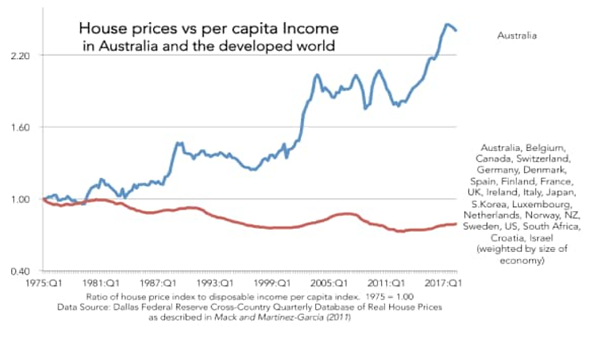
www.news.com.au/finance/economy/australian-economy/viral-graph-shows-house-price-danger/news-story/8ef84bdc2aaa5bb589aa77da5522d45b

Murphy, Jason, ‘Viral Graph shows House Price Danger’ 16 November 2018 www.news.com.au/finance/economy/australian-economy/viral-graph-shows-house-price-danger/news-story/8ef84bdc2aaa5bb5


[1] www.buildsydney.com/australian-housing-bubble/

[2] Walters, Stephen ‘The Risks in Rising Australian Household Debt’ 1 August 2018 http://aicd.companydirectors.com.au/membership/company-director-magazine/2018-back-editions/august/economist

[3] www.abc.net.au/news/2018-12-10/immigration-australia-skill-english-salary-concessions-regions/10355054

[4] NSW Parliamentary Estimate Portfolio Committee 6 Transcript of hearing 12/9/19 p 35  www.parliament.nsw.gov.au/lcdocs/transcripts/2240/Transcript – 12 September 19 – UNCORRECTED – PC 6 – Customer Service – Dominello.pdf

[5] www.afr.com/policy/economy/can-t-rely-on-monetary-policy-alone-20190702-p5239x

[6] www.rba.gov.au/publications/rdp/2009/pdf/rdp2009-07.pdf

[7] www.huffpost.com/entry/food-stamp-myths_b_1334924

[8] www.fns.usda.gov/nslp

[9] /www.nzschoolnurses.org.nz

[10] www.smh.com.au/education/un-agency-ranks-australia-39-out-of-41-countries-for-quality-education-20170615-gwrt9u.html

[11] https://insidestory.org.au/what-gonski-really-meant-and-how-thats-been-forgotten-almost-everywhere/

[12] Seccombe Mike, ‘How John Howard’s Tax Cuts undid his protégé, Tony Abbott’ The Saturday Paper 20/12/14


[i]Pash, Chris ‘Here’s a look at the widening gap between wages and house prices’ 6 March 2018  www.businessinsider.com Image result for Sydney Rents v median income graph.au/chart-australian-wages-house-prices-2018-3
[ii] www.aph.gov.au/About_Parliament/Parliamentary_Departments/Parliamentary_Library/pubs/rp/rp0809/09rp30#_Toc228933532

Kryger, Tony ‘Australia s foreign debt data and trends’ Research Paper no. 30 2008–09, 7 May 2009

Note that this graph only goes to 2011

Continue Reading
Continue Reading

Veterans’ PTSD costs $241 million 3/1/21

Some time ago. I was driving through Western Sydney and saw a huge billboard for army recruitment.  An interesting and challenging job, training for a trade etc.  I then stopped in a supermarket and there was a much smaller ad for a charity that helped Veterans who were victims of Post-Traumatic Stress Disorder.  I wondered why they needed a charity when the Dept. of Veterans’ Affairs has a much larger budget per patient than anyone else.

I asked a clinical psychologist friend of mine about this.  The psychologist had a good practice and admitted that a lot of work came from ex-Veterans, commenting nervously that almost all the Veterans had PTSD, but that it was a closely guarded military secret.  I was not surprised.  I had read ‘Exit Wounds- One Australian’s War on Terror’ by John Cantwell, the ex-commander of the Australian forces in Afghanistan.  He had PTSD and took himself off the short-list to be the chief of Australian defence to go into a psychiatric hospital for treatment.  He wrote in 2013 that the war in Afghanistan could never be won and that every Australian life lost there was wasted.  Troops are still there, presumably until the Americans all leave.

In 2019 I went to a pub dinner with a group I knew vaguely at a hotel in Kings Cross.  I had arrived late from work and as I moved to the end of our table, a man sitting alone on the next table moved his pack so that I could get in. I nodded thanks.  My group said a brief ‘hullo’ and went on with a conversation about people I did not know, so I remained a little detached.  After a while the man on the next table stood up and asked me in a broad Scottish accent if I would mind looking after his pack while got another beer.  He was unshaven and looked very dejected, perhaps in his early forties in age but his clothes were new.  I moved his pack so that it was more directly in my line of sight, and noticed that it was a state of art pack, perhaps a military one.  When he returned I asked him what part of Scotland he was from.  (This is always a good opening line for Scots as they hate being asked what part of England).  He said that he was a stonemason, who had lived with his single mother until she had become unwell with memory loss and needed institutional care. He wanted to get a ‘powder ticket’ so that he could have his own quarry. He could not afford this training so he had joined the British Army. Seemingly he learned his explosives quite well and was posted to Afghanistan. He had had to do ‘a job’ involving explosives and was praised by his commander as he had apparently done it well from a military point of view.

He did not elaborate much at this point as he choked back his tears, but he felt utterly worthless and had asked for an immediate discharge from the army. He had an elder brother in Australia from whom he had been estranged since his parents separated when he was young and he had in arrived in Australia this very morning to find his brother at the most recent address he had.  He had no phone number or email.  The brother had left the address, so he had stopped for a drink. He had no friends, no country and was very, very depressed. 

As his tale unfolded, I was increasingly wondering what I could do, but in this case luck was with us both.  One of the others on the table I was in theory still having dinner with had started to listen to our conversation.  She was a counsellor in the Kings Cross area and joined in. She took over and found him accommodation, promising to get him some PTSD counselling when she finished a morning appointment the next day, and quite subtly got him to promise reciprocally not to commit suicide overnight. 

I followed this up with the counsellor and she was apparently successful.  He went with an Australian PTSD sufferer to a farm in the Central West where rehab is done for ex-Afghanistan veterans. Hopefully it was successful longer term.

But this story is largely luck, and success is not assured.  Here was the real face of the foreign policy stupidity in the Middle East, and prevention is far better than any hoped-for cure. 

The Vietnam war may have been ‘lost’  on the TV screens of America, but it is highly dubious that it could have been won anyway.  Iraq, Libya, Syria and Afghanistan do not look like having any chance of the West winning. But since the Falklands war, journalists are embedded with the Army and so are on one side that gives them protection and restricts their information, so there is no peace movement of any political note to stop the foolish machinations of Australia in fawning to please the US in wars.

I am not sure that Veterans have ‘unlimited access’ to mental health services- if they did, why would there be charities appealing for support?  My experience is that all funding bodies including Veterans Affairs try to deny the existence of a problem.   It seems the concern of the article is the cost of the rehab. The answer of course is to stop the war. 

The Buttery mentioned was the one of very few live-in addiction rehab programs that I could find when I was in Parliament.  It was near Bangalow on the North Coast and had endless trouble getting funding.  If it is now exclusively used by Veterans others will be missing out.

www.smh.com.au/politics/federal/bill-for-veterans-mental-health-care-reaches-241m-with-20-000-in-rehab-20201030-p56a9w.html

Continue Reading

Privatisation of Research will Kill Millions due to Vaccine Non-Availability 30/12/20

The COVID vaccines were an international race.   Many countries and companies competed.  The Uni of Queensland one fell over because it made the AIDS test a false positive.  There are now 5 principal ones in the media; Pfizer from Germany, Astra-Zeneca/Oxford from the UK, Moderna from the USA, Sputnik 5 from Russia, and Sinovac from China.  Over here we ignore the two from Russia and China, for some reason.  Do we not trust them, are we just racist, or do we want to support Big Pharma in ‘The West’?

I recently met with some medical sceptics, who said that there is no public proof that the vaccine works, i.e. published papers.  I said that it was in the media that there had been a 43,000 person trial with not very many side effects. They conceded that this was correct, but pointed out that you could inject water  into 43,000 people with few side effects, and that it was a question of how many of the 43,000 had been exposed to the virus, compared to a group of 43,000 in the same environment who had not been vaccinated.  And you could not ask a volunteer who had just had the vaccine to cuddle up to a COVID case- that would be foolhardy.  Their key point was that all the data was still in the drug companies’ hands and not publicly available.  Presumably the regulatory authorities have it, and hopefully they are still being rigorous under the pressure.  We have to assume the vaccines work as we need to open up the world economy.

Our government promised a fortune to these companies before they even had a product to sell, and all the bluster about having an equal world in terms of vaccine access does not seem to have dollars attached.   At present there is not enough vaccine to go around, but it still matters where you start.  Logically, vaccinating Australians where there is very little infection would likely save fewer lives than vaccinating people where the virus is rampant.

I have told the story before about Jonas Salk, who developed the polio vaccine with public funds and did not patent it so that the maximum amount of vaccine could be distributed to rid the world of polio.  This was in sharp contrast to Glaxo, the drug company, which found that an old unpatented drug worked against AIDS, patented it and then insisted that the price of it be at least $US2 a day, although an Indian company said that they could produce it for 7 cents.  The result was several million extra AIDS cases in Africa.

Sadly the Human Papilloma Virus (HPV) vaccine, Gardasil was a similar story.  HPV was found to be the cause of cervical cancer.  The vaccine was developed at Uni of Queensland by Prof Ian Frazer, and then marketed by CSL and Merck.  Its roll out was considerably delayed by its cost, despite the fact that the Uni of Qld declined to insist on royalties from sales in developing countries.  It is still $73 a shot in Australia (2 needed, 3 recommended), though our government makes it free to Australian schoolchildren.

This article says that the Coronavirus vaccines will worsen inequalities.  This is true, because not only will poorer countries not be able to afford the vaccine, they will also have more people die and have higher health costs as they will have to treat the cases. It will also have a bigger impact on their economies.  The fine rhetoric about sharing world knowledge will certainly be tested.  It might be noted that the Chinese released the draft genome of the Coronavirus to the world in January 2020 (Sciencemag.org) in the interest of stopping the outbreak, which was a credit to China and gives credence to their vaccine.  On the other hand, I seem to recall that Pfizer declined to be involved in information sharing, but have been unable to find the reference for this.

Pfizer did not get public funding but their development partner, BioNTech, did.   The question is how much profit will there be in all this, and how much will the price stop poorer countries getting the vaccine.

The fact that governments no longer fund the research directly and go into ‘private-public partnerships’ gives rise to the feeling that governments put in the funds but the private partners both determine the priorities in research with a bias towards research that can make a profit and then make that profit.  The governments then either largely fund the profit, or leave their populations unable to benefit from the research that they as taxpayers funded.

I have two relevant articles on this, one below, and one coming shortly.

www.internationalhealthpolicies.org/featured-article/why-does-pfizer-deny-the-public-investment-in-its-covid-19-vaccine/

https://amp.theage.com.au/business/the-economy/a-pitiful-response-global-economic-inequality-a-side-effect-of-vaccines-development-20201226-p56q99.html

Continue Reading

Cooperation on COVID Vaccines? 13/12/20

We hear a lot about 3 COVID vaccines; the Pfizer one being rolled out in the UK last week and in the US from tomorrow, the Oxford Astra-Zeneca one that is imminent, cheaper and has less problems with refrigeration, and the Moderna one, which is US based and does not yet seem to have a launch date.

There are two other vaccines in the news, the Russian Sputnik V one being rolled out there and in Eastern Europe, and the Chinese Sinopharm one that is going into Indonesia, India and elsewhere.  But it seems that no one is considering bringing these two into the Western world.  We might ask, ‘Why not?’

Is it racist?  Do we think their scientists are no good and would fake the results?   Are we simply in the thrall of Western pharmaceutical companies with captive regulators?  Perish the thought, would their vaccines be cheaper?  China has 1.3 billion people to protect and have goes to a lot of trouble to do so.  They had scientists working with the US until the fuss started.  They had a head start in the vaccine race.  If the vaccine did not work they would have wasted a lot of time and effort vaccinating their own country and would suffer a huge loss of face.  It seems unlikely that their vaccine does not work.  So again, why no evaluation here?  If Australia asked the Chinese to give us the data on their vaccine to evaluate it for licence here, it would be a nice peace gesture in the needless spat that was created when Morrison accused the Chinese of hiding the origins of the COVID epidemic.

It seems that some scientists in Britain and Russia have suggested cooperation between the Oxford and the Russian Sputnik V vaccine. This story is from RT- Russia Today. Will this actually happen?

www.rt.com/russia/509340-astrazeneca-sputnikv-vaccine-collaboration/

Continue Reading

COVID19 Vaccine Roll Out 11/12/20

People are asking me if they should get vaccinated. It shows how trust in our institutions has been eroded. A few years ago no one would have questioned it.

The side effects are far less than the death rates from COVID, particularly in older age groups or those with other health conditions. COVID also seems to have a considerable amount of long-term after-effects in a significant percentage of people; note the difference between the infection rate and the recovered rate in the statistics. (Of course some may have just been lost to follow-up).

Children seem to have few symptoms, but if they are not infected and grow older without immunity, it would be ironic if they are then badly affected later. Mumps is like that- relatively trivial in youth, but can cause pancreatitis, encephalitis and sterility later. Years ago in the pre-vaccination days, if a child had chicken pox or measles, the mothers would all bring their children to be deliberately infected at a ‘Pox Party’, though these are now discouraged. This sort of immunity may well be spreading and giving herd immunity in countries that have COVID now endemic, but it would be unwise to do it here as it would spread it to more vulnerable demographics.

Chicken pox can cause herpes zoster (shingles) in older folk, which is very painful, and now has a vaccine (Zostavax) that is very expensive but free after age 70.

This article is about the Oxford-Astrazeneca vaccine, which is not the Pfizer one that is currently being rolled out in the UK. It seems that the Oxford one is the first to publish the results of a Phase 3 trial, and though a lot of people have been vaccinated, not many people have been infected, which means that the numbers on which the conclusions are drawn are still not large. There is an embedded link in the article that gives a good summary of the trial procedures. It seems that the Oxford vaccine will have the advantages that it is easier to store, and transport and is cheaper. Presumably as this article is now published, its roll out is imminent also.

From an Australian perspective, there is now a huge rollout of the Pfizer vaccine in the UK, so we will know exactly how well it works by the time it gets here.

It is sad that the Qld Uni vaccine has been abandoned as it gives a false positive for the HIV/Aids Antibody test. Presumably it would have worked, and perhaps an alternative HIV/Aids test might have distinguished the two apart.

https://theconversation.com/the-oxford-astrazeneca-vaccine-is-the-first-to-publish-peer-reviewed-efficacy-results-heres-what-they-tell-us-and-what-they-dont-151755?utm_medium=email&utm_campaign=Latest%20from%20The%20Conversation%20for%20December%2011%202020%20-%201808017569&utm_content=Latest%20from%20The%20Conversation%20for%20December%2011%202020%20-%201808017569+CID_01f3cb2f6f072670ce3f7d184deeafcf&utm_source=campaign_monitor&utm_term=The%20OxfordAstraZeneca%20vaccine%20is%20the%20first%20to%20publish%20peer-reviewed%20efficacy%20results%20Heres%20what%20they%20tell%20us%20%20and%20what%20they%20dont

Continue Reading

US Health System and COVID-19 11/12/20

Here is an article about the US Health system and its response to COVID. Basically it seems that the US government is subsidising COVID treatments so that they are more lucrative than treatment of other diseases, so the private operators are filling their hospitals with COVID patients whether they need to be admitted or not, and non-COVID patients are excluded.

The other thing that is interesting is that there has been a huge growth in administrators since the 1970s. It has to be understood why private health systems are so inefficient. They have to keep individual insurance databases to keep track of premiums and churn as people change funds. When someone is treated they have to account for every band aid, visit, procedure or investigation, bill the patient and pay the practitioner. They have to market their product, compete for staff, and then figure out ways to avoid paying if possible.

Universal systems have everyone eligible, so do not need to worry about who is getting treated. No need to market the system, maintain many different churning databases, compete for doctors, keep accounts for every details of every treatment and bill and pay for them individually.

In terms of better health care there is no problem of adapting to whatever disease needs the most attention as the staff are motivated to do the most effective treatments, and there is no distortion of priorities to maximise profits.

The US health system is the least effective in the developed world in terms of delivering health care. but it is the most effective at its primary object- turning sickness into money.

No one has looked too closely at why the Australian system has been able to respond. Basically our public health system is State-based hospitals, which are still largely public and have doctors who could be re-directed to testing and vaccination. They can also change to do COVID if needed, and treat disease on their merit.

The private hospitals did very well out of the government subsidies here because they were emptied ready for a COVID influx that never came and they just pocketed the cash without much publicity for this from either themselves or the Government.

Australia has continued on its previous course, which is to starve Medicare and help the private system move towards a US system by stealth, and the COVID pandemic has so far not brought this to light. What is left of the public system has done well, helped by the fact that we are an island nation, so had some warning and could act to quarantine ourselves. The government was happy to take advice from the medical professionals because it had made such a mess of not taking advice from the firefighting professionals. But Medicare is still being quietly destroyed and we are moving to a US system of private medicine.

The government saves money on Medicare doing this, even though the system is much less efficient and much less equitable. But the key reason is not the savings on Medicare, it is the money to the Party coffers from the Private Health Industry (PHI), which is now much stronger with the changes John Howard did to the Aged Care system in 1997, which made it effectively a for-profit system, and the NDIS also a for-profit system, subsidised by the taxpayer through the Medicare levee, which was ironically not being used for health. (The discussion of the Aged Care system was in one of my posts last week).

The key thing to understand in the destruction of Medicare is that the rebate to doctors which was set at 85% of the AMA fee, so as to replace private medicine, has risen at half the inflation rate for 35 years and is now 46% of the AMA rate. Doctors are paid half what they were, so specialists mostly will not use it, and GPs who still bulk bill just do shorter visits.

Here is the article on the US response to COVID. Their prevention is also hopeless, as with such a poor welfare system the people cannot afford to stop work, and the story that it was a hoax was also promoted by President Trump. The obsession with ‘individual rights’ sits uneasily with the idea of staying home for the common good, and makes disinformation campaigns easier. People wanted to believe it was a hoax, because they could not afford to stop work anyway.

http://www.informationclearinghouse.info/55999.htm

Continue Reading

Aged care: What is the prognosis? 15/11/20

I attended a DRS (Doctors Reform Society) zoom webinar on the future of health care with Professor Stephen Duckett and aged care with Professor Joseph Ibrahim of Monash Uni, a geriatrician whose experience is in evidence-based aged care.

It was not encouraging.

Preamble:

My own experience of nursing homes was initially as an after-hours doctor when I used to judge nursing homes by what I turned the Urine Smell Index; the worst ones smelled of urine when you opened the door at night.  As a GP years ago I found it increasingly difficult to find someone trained to talk to about the patients’ treatments.  

In New South Wales Parliament as an MP I was asked to pass legislation that lessened the number of trained nurses required on staff.  ‘Flexibility’ was the key and many homes and facilities ‘had people who were not really sick’ we were told.  I was not convinced but the legislation went through anyway.

When my widowed mother was no longer able to cope at home and the family went looking for supported accommodation it soon became clear that the driving force in Aged Care is real estate profits.  The family home is sold and the object is to get the family to buy an overpriced retirement Villa with varying levels of support in the villa and then hopefully automatic entry into an attached nursing home, usually with quite a poor urine smell index. When the old person dies the villa profit largely reverts to the corporation.

A dear old widower professor who lived up the road needed support in his 90s. The home support contract offered needed at least 4 hours per week at $65 per hour.  The person delivering the care was paid $20 an hour.  I am unsure how District Nurses are allocated.  

In 2000 Prime Minister Rudd asked for ideas for his ‘2020 Vision’.  I wrote and suggested that he register the skills and training of Home Care workers so that they could be hired and evaluated like Uber of any other online service and the ‘quality control and insurance’ would not be why the contracting agency became so ‘vital and expensive’ (that it would end up costing more than the person who actually did the work).  I never even had an acknowledgement  of my suggestion.  

Prof Duckett was of the opinion that things had got a lot worse since the 1997 Aged Care Act, John Howard’s work, which created ‘a business opportunity’   Prior to this there was a system called CAMSAM which was two modules; Care Aggregated Module and Standard Aggregated Module.  These were funded separately.  If they did not spend their Care money it was forfeited, so they could only profit on Services.

After 1997 there was no distinction so profits could be made from either component, so the quality of care declined, usually with lower staffing levels.

Some private-for-profit nursing homes have good care, but this is not common.  Some not-for-profits also had very poor care, but the general rule is that the standard of care relates to the number and training of staff.  The low wages (approximately equals $20 per hour) mean that the staff need to work multiple jobs in multiple locations which is what spread the COVID epidemic in Melbourne.  Government run homes tended to have better staffing ratios, so were better able to act against the infection.

 Professor Joseph Ibrahim commented that the terms of reference of the current Royal Commission on Aged Care were very narrow, only covering 5 years, and could not lead to prosecution.  He felt that this was deliberate.   The issues of overprescribing and assault have come up often.

He felt that this meant that it’s conclusions might be weaker and then not implemented, with a tendency to kick difficult problems down the road.

The commissioners themselves were of interest:

Richard Tracey had died before the enquiry started

Another, a Western Australian prosecutor had opted out (an unusual action as being on a Royal Commission is normally a good career move).

The two final commissioners are:

  1. Tony Pagoni,  Chairman- a retired judge who had had a specialisation in tax law and
  2. Lynette Briggs- a career health bureaucrat

Commissioner, Briggs has put out a report asking that aged care be returned to the control of the health department.  Prof Ibrahim comments that is very unusual for one Commissioner to make a public statement before the final report and this indicates that the commissioners are not in agreement.

Currently there are about 250,000 care workers and about 200,000 Professionals.  The care workers need six weeks training at a TAFE level to get a ‘Certificate 3’  About 1/3 are new migrants. They are paid about $20 per hour and casualised to decrease staff costs. The unions are worried that the new RECP (Regional Comprehensive Economic Partnership) trade treaty actually allows trade in people and that more visas for cheap labour in these areas will not help residents or local jobs.

The $20 billion dollar industry is founded approximately $14.5 billion from government, $4 billion from RADS and $2-4 billion for additional services. 

There are not-for-profits, but the large for-profit providers have increased since the 1977 act and are largely highly profitable big corporations, some multinational like BUPA.

 Professor Ibrahim is concerned that there is a lack of supervision.

There are no forensic accountants looking at what it costs to run an aged care facility and this has allowed supernormal profits by big players.  Money has been spent poorly or ‘hived off’. Obviously if the government runs some homes themselves there will be public service experience.

Prof Ibrahim believes that the future directions of aged care will be set by the multinational for-profit providers because these are the people who have direct access to the government. There is no significant advocacy for aged care residents.  He contrasts this with breast cancer advocates who pressed for less radical operations, and for Gay men who pressed for more enlightened AIDS/HIV policies. 

There have been discussions of ‘quality-of-life’ that have tended to be spoken of as needing less healthcare, but quality of life cannot be good without good health care.

The aged care industry likes home care as it lessens their costs and also pushes the liability back onto GPs.  A sense of proportion is necessary:

There are 2.5 million well older people and 200,000 in aged care.

             More radical treatments are now done in older age groups such as dialysis or cardiac surgery in the over 90s, very is some debate over this period some would say that it is a just to deny routine treatments but there is some distortion of priorities by having these lucrative procedures as fee-for-service, and there is also some inequity.

Since the development of antibiotics, medicines are seen as curative, but in fact they should be seen as being in three classes:

1. Curative 

2. Palliative

3. Preventative

There is quite a lot of cost-ineffective medication use, such as for osteoporosis. 

Solutions. (These are not just from the presenters)

  1. A national registration system for all levels of care workers period this should include people who do home help with shopping cleaning and gardening as well as Medical & personal care workers.
  2. Existing TAFE courses should be recognised but more courses will be needed.
  3. There needs to be a feedback database for complaints/praises and ratings as there is for AirBNB, restaurants etc.  The feedback database needs to be actively monitored by the regulator to follow up complaints or untoward events. 
  4. There needs to be a regulation system with accreditation and regular random inspections of facilities and surveys of residence.
  5. Academic researchers such as AIHW (Aust. Institute of Health and Welfare) should be at arm’s length and should have long-term commissions to do longitudinal studies of aged welfare and satisfaction so that individuals cannot be targeted if they state that they are not happy with the care in their institutions. 
  6. This should be combined with health research.
  7. There should be formal structured feedback systems with residents’ groups having paid advocacy groups and formal places and rights on regulatory bodies.
  8. There must be minimum wages and conditions for all workers and minimum staffing standards.
  9.  The Regulatory body must have a policing function, supervising staffing and wage levels and food and care standards

Final Comment

Note there are a large number of public submissions on the Royal Commission website, many of which make discouraging reading.  The privatisation seems to have led to profit-seeking rather than an improvement in care, and the  political forces seem likely to continue this.

http://agedcare.royalcommission.gov.au

Continue Reading

Medicine, Reality and the US vote 11/11/20

Doctors tend to assume that everyone knows certain things, particularly because everyone they meet usually does. They also tend to think that everyone knows the order of importance of what they know.

Many years ago as I started to campaign against tobacco, Henry Mayer, the first Professor of Political Economy in Sydney, who had a regular column in the SMH told me that the health people were invisible in the media on the tobacco issue. I said that this was ridiculous, it was the most studied subject in the history of medicine, with over 60,000 papers and growing daily. He pointed to a person called Tollison, who wrote in the non-medical media that was read by the business sector. There were no medical responses there. The mainstream also media had relatively little on tobacco, as tobacco advertising was one of the major sources of revenue.

So the harm of tobacco was known, but ignored, like the fact that you are going to die one day.

It came home to me, when I amputated the leg of a smoker for vascular disease. He had bad lungs and a bad heart. I said, ‘Look mate, if you keep smoking, you will lose the other leg.’

To my amazement he replied, ‘Look, all you doctors go on about smoking, but if it was as bad as you say it is, the government would do something about it’.

He had internalised the government’s non-action as being mute testimony to it not being a problem. Doctors are, after all a subculture that claims to have expertise in a certain area, as do engineers, educators, weather forecasters and many other groups. In tobacco, the Tobacco Industry, the Australian Hotels Association, Clubs and Pubs and the advertisers and sponsorship recipients fought like tigers to stop reasonable public health policy. They are probably still retarding it- there has not been a Quit campaign in Australia for over a decade.

Trump’s denial of the significance of COVID19 must have struck a chord with those who knew that in the absence of decent welfare system a lockdown would send them broke. They needed to believe that they could carry on, and he and his denial were their salvation. A lot of business interests supported them- they would go broke too.

So it was interesting that the health facts became politicised, and wearing a mask was as much a political statement as a medical one. Politics was not, and will not be in future a good basis for personal preventive heath decisions. So controlling the COVID epidemic in the US will be harder than here, where mainly apathy and complacency are in the way.

The figures that only 4% of people in the US changed their view on the dangers of COVID goes some way to explaining why Biden did not have a landslide. For many people, COVID was not an issue, Trump’s rhetoric was plausible if you did not fact-check, and the economy had been going OK prior to the epidemic.

SMH today:

Virus neglect didn’t infect Trump vote

Shaun Ratcliff

📷

Since the first person was diagnosed with COVID-19 in the US, more than 10 million cases have been confirmed and nearly a quarter of a million people with the virus have died.

Watching from afar, in a country where the coronavirus has been significantly less lethal, it is surprising the incumbent president did as well as he did.

While the pandemic probably did cost him votes, surveys we have run over the course of the year showed there are strong partisan effects on attitudes towards COVID-19, with supporters of Donald Trump mostly unconcerned about the risks from the virus, and getting less worried as the year went on.

These surveys were run in May and September. Both surveys consisted of responses from more than 1000 Americans.

In May, approximately 40 per cent of all Americans were very or extremely worried about the possibility they or a family member might catch the virus. Almost the exact same number were only a little or not at all worried. According to our data, this level of concern actually declined slightly between May and September.

This was largely a partisan affair. Respondents who said they were going to vote for Joe Biden retained a similar level of concern during this period, with 48 per cent very or extremely worried in May, and 50 per cent in September.

However, respondents who said they would vote for Trump were not very concerned about COVID-19 in May – about 19 per cent reported they were worried about it in the first survey and just 11 per cent of Trump voters reported this level of concern in the second survey.

The partisan differences, and the declining trend in Republican concern about COVID-19, are largely the product of the extremely polarised media and political environment in the US.

Trump voters are less trusting of information on COVID-19 from medical experts than Biden supporters, and between May and September a quarter of Republican voters became less likely to trust information from these experts.

This difference may, in part, stem from the media through which they obtain information. Those with the lowest levels of trust tended to rely upon more conservative cable and online news like Breitbart and Fox News, for instance, which have played down the risk posed by the pandemic.

Republicans who rely more on these conservative media outlets were more likely to have lower levels of trust in medical experts, even after controlling for demographic differences between Democrats and Republicans. They were also as likely to trust Donald Trump as medical experts for information on the coronavirus.

In this polarised environment, very few voters abandoned Trump between May and September (only about 4 per cent in our data), and hardly any shifted to support Biden.

Trump supporters tended to align their position on the coronavirus with their political allegiance. Relying more on media that downplayed the significance of the coronavirus, and taking cues from Republican leaders, they decided the pandemic was not a significant threat.

Our data indicates Biden was able to win over a small number of voters who supported neither candidate at the start of the year. It was enough to win in the end, but not enough to deliver the predicted landslide.

Shaun Ratcliff is a lecturer in political science at the United States Study Centre, University of Sydney.

Continue Reading

Marketing Obesity to Children 11/10/20

About 37 years ago BUGA UP (Billboard Utilising Graffitists Against Unhealthy Promotions) identified the problem of advertisers marketing to children and produced a guide, ‘AdExpo- A Self-Defence Course for Children’.  It was in black and white as BUGA UP had no money and the ads are a bit dated now, but the text us still relevant.  www.bugaup.org/publications/Ad_Expo.pdf

Advertisers market to children, and are successful with it.  Now there is the internet, which has made things a lot worse.  Kids can be targeted with the parents only dimly aware of what is going on, and before the kids have actually been formally ‘taught’ anything.  The ads are part of the exciting environment that their little heroes show them.  At last attention is being drawn to this.  This article is from the NY Times, with a cut-down version in the SMH of 7-8/11/20.

Are ‘Kidfluencers’ Making Our Kids Fat?

By Anahad O’Connor, NY Times 30/10/20

Popular YouTube channels often bombard young children with thinly veiled ads for junk food, a new study finds.

One of the most popular YouTube videos from Ryan’s World shows its star, Ryan Kaji, pretending to be a cashier at McDonald’s.  “It’s a stealthy and powerful way of getting these unhealthy products in front of kids’ eyeballs,” a public health expert says.Credit…via YouTube

That is the conclusion of a new study published on Monday in the journal Pediatrics. The authors of the study analyzed over 400 YouTube videos featuring so-called kid influencers — children with large social media followings who star in videos that show them excitedly reviewing toys, unwrapping presents and playing games. The study found that videos in this genre, which attract millions of young followers and rack up billions of views, were awash in endorsements and product placements for brands like McDonald’s, Carl’s Jr., Hershey’s, Chuck E. Cheese and Taco Bell.

About 90 percent of the foods featured in the YouTube videos were unhealthy items like milkshakes, French fries, soft drinks and cheeseburgers emblazoned with fast food logos. The researchers said their findings were concerning because YouTube is a popular destination for toddlers and adolescents. Roughly 80 percent of parents with children 11 years old or younger say they let their children watch YouTube, and 35 percent say their children watch it regularly.

A spokeswoman for YouTube, citing the age requirement on its terms of service, said the company has “invested significantly in the creation of the YouTube Kids app, a destination made specifically for kids to explore their imagination and curiosity on a range of topics, such as healthy habits.”  She added, “We don’t allow paid promotional content on YouTube Kids and have clear guidelines which restrict categories like food and beverage from advertising on the app.”

Young children are particularly susceptible to marketing.  Studies show that children are unable to distinguish between commercials and cartoons until they are 8 or 9 years old, and they are more likely to prefer unhealthy foods and beverages after seeing advertisements for them.

Experts say it is not just an advertising issue but a public health concern.  Childhood obesity rates have skyrocketed in recent years: Nearly 20 percent of American children between the ages of 2 and 19 are obese, up from 5.5 percent in the mid 1970s.  Studies have found strong links between junk food marketing and childhood obesity, and experts say that children are now at even greater risk during a pandemic that has led to school closures, lockdowns and increased screen time and sedentary behavior.  The new findings suggest that parents should be especially wary of how children are being targeted by food companies on social media.

  • Thanks for reading The Times.

Subscribe to The Times

“The way these branded products are integrated in everyday life in these videos is pretty creative and unbelievable,” said Marie Bragg, an author of the study and an assistant professor of public health and nutrition at the New York University School of Global Public Health.  “It’s a stealthy and powerful way of getting these unhealthy products in front of kids’ eyeballs.”

Dr. Bragg was prompted to study the phenomenon after one of her co-authors, Amaal Alruwaily, noticed her young nieces and nephews obsessively watching YouTube videos of “kidfluencers” like Ryan Kaji, the 9-year-old star of Ryan’s World, a YouTube channel with 27 million subscribers, formerly named Ryan ToysReview.

The channel, run by Ryan’s parents, features thousands of videos of him excitedly reviewing new toys and games, doing science experiments and going on fun trips to stores and arcades.

Children’s channels like Ryan’s World — which are frequently paid to promote a wide range of products, including toys, video games and food — are among the highest grossing channels on YouTube, raking in millions of dollars from ads, sponsored content, endorsements and more.   According to Forbes, Ryan earned $26 million last year, making him the top YouTube earner of 2019.  Among the brands he has been paid to promote are Chuck E. Cheese, Walmart, Hasbro, Lunchables and Hardee’s and Carl’s Jr., the fast food chains.  One of his most popular videos shows him pretending to be a cashier at McDonald’s.  In it, he wears a hat with the McDonald’s logo, serves plastic Chicken McNuggets, cheeseburgers and French fries to one of his toys, and then eats a McDonald’s Happy Meal.  The video has been viewed about 95 million times.

“It looks like a normal child playing with their normal games, but as a researcher who studies childhood obesity, the branded products really stood out to me,” Dr. Bragg said.  “When you watch these videos and the kids are pretending to bake things in the kitchen or unwrapping presents, it looks relatable.  But really it’s just an incredibly diverse landscape of promotion for these unhealthy products

In a statement, Sunlight Entertainment, the production company for Ryan’s World, said the channel “cares deeply about the well-being of our viewers and their health and safety is a top priority for us.  As such, we strictly follow all platforms terms of service, as well as any guidelines set forth by the FTC and laws and regulations at the federal, state, and local levels.”

The statement said that Ryan’s World welcomed the findings of the new study, adding: “As we continue to evolve our content we look forward to ways we might work together in the future to benefit the health and safety of our audience.”

Other popular children’s channels on YouTube show child influencers doing taste tests with Oreo cookies, Pop Tarts and Ben & Jerry’s ice cream or sitting in toy cars and ordering fast food at drive-throughs for Taco Bell, McDonald’s, Burger King, KFC and other chains.  “This is basically a dream for advertisers,” said Dr. Bragg.  “These kids are celebrities, and we know from other rigorous studies that younger kids prefer products that are endorsed by celebrities.”

To document the extent of the phenomenon, Dr. Bragg and her colleagues identified five of the top kid influencers on YouTube, including Ryan, and analyzed 418 of their most popular videos.  They found that food or beverages were featured in those videos 271 times, and 90 percent of them were “unhealthy branded items.”  Some of the brands featured most frequently were McDonald’s, Hershey’s, Skittles, Oreo, Coca-Cola, Kinder and Dairy Queen.  The videos featuring junk food have collectively been viewed more than a billion times.

The researchers could not always tell which products the influencers were paid to promote, in part because sponsorships are not always clearly disclosed.  The Federal Trade Commission has said that influencers should “clearly and conspicuously” disclose their financial relationships with brands whose products they endorse on social media.  But critics say the policy is rarely enforced, and that influencers often ignore it.

McDonald’s USA said in a statement that it “does not partner with kid influencers under the age of 12 for paid content across any social media channels, including YouTube, and we did not pay or partner with any of the influencers identified in this study.  We are committed to responsibly marketing to children.”

Last year, several senators called on the F.T.C. to investigate Ryan’s World and accused the channel of running commercials for Carl’s Jr. without disclosing that they were ads.  The Council of Better Business Bureaus, an industry regulatory group, also found that Ryan’s World featured sponsored content from advertisers without proper disclosures.  And a year ago the watchdog group Truth in Advertising filed a complaint with the F.T.C. accusing the channel of deceiving children through “sponsored videos that often have the look and feel of organic content.”

In March, Senators Edward J. Markey of Massachusetts and Richard Blumenthal of Connecticut introduced legislation to protect children from potentially harmful content online.  Among other things, the bill would limit what they called “manipulative” advertising, such as influencer marketing aimed at children, and prohibit websites from recommending content that involves nicotine, tobacco or alcohol to children and teenagers.

The F.T.C. has long forbidden certain advertising tactics on children’s television, such as “host selling,” in which characters or hosts sell products in commercials that air during their programs.  Critics say the agency could apply the same rules to children’s programs on the internet but so far has chosen not to.

“It’s beyond absurd that you couldn’t do this on Nickelodeon or ABC but you can do this on YouTube just because the laws were written before we had an internet,” said Josh Golin, the executive director of the Campaign for a Commercial-Free Childhood, an advocacy group.

“These videos are incredibly powerful,” he said.  “Very busy parents may take a look at them and think that it’s just a cute kid talking enthusiastically about some product and not realize that it’s often part of a deliberate strategy to get their children excited about toys, or in the case of this study, unhealthy food.”

Anahad O’Connor is a staff reporter covering health, science, nutrition and other topics. He is also a bestselling author of consumer health books such as “Never Shower in a Thunderstorm” and “The 10 Things You Need to Eat.” 

Continue Reading